
 |
 |
 |
 |
 |
 |
 |
 |
 |
 |
 |
 |
 |
 |
 |
 |
 |
 |
Return to Tips for Trombone |
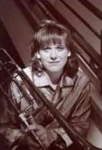
by Dr.
Deb Scott |
| Placement
of the Tongue Slurring Alternate Positions Vibrato Glissando (Gliss) |
Placement of the Tongue
The placement of the tongue actually changes throughout the range of the instrument. It is probably not necessary to point this out to students, because most make this adjustment naturally. For that reason, I teach "TOO" and "DOO" respectively for Staccato and Legato tonguing.
- Staccato
- TOO (middle range)
- TAH (low range)
- TI -- I as in it (high range)
- Legato - use a soft "D"
- DOO (middle range)
- DAH (low range)
- DI -- I as in it (high range)
- The trombone is the only wind instrument without a true slur.
- A light tongue must be used to separate the air flow for the slide to move. If the tongue is too hard, slurring will not occur. If the tongue is too soft, glissandos may occur.
Syllables for Slurring:
DOO (middle range)
DAH (lower range)
DI -- I as in it (upper range)
- The slide action must be quicker between slide positions since there is less time between tones.
- Breath support!
- Alternate positions should be taught early so that players don't cling to familiar positions.
- The more notes played with the slide going in one direction, the better.
- Half steps should be played with adjacent positions whenever possible.
- Alternate positions have a slightly inferior quality of sound and should not be used for "prominent" notes.
- Teach at least 3 alternate positions to your trombone players and encourage them to use them!
- 4th line "F" in 6th
- "D" above middle "C" in long 4th
- Top of the staff "Bb" in short 5th
- Jaw Vibrato is the best vibrato to use for classical solo purposes. (Practice chewing gum.) Use only on long notes; start slow to fast. Listen to recordings of professional musicians.
- Slide Vibrato is used in the jazz idiom. In a jazz band soli trombone section, only the lead player should use it.
- A gut or air vibrato should never be used!
- When two different tones are sounded within the same partial, using no tongue produces a glissando effect.
- Use lots of air and blow through the glissando.
- The slide may be moved slowly or quickly for the desired effect.
| The Texas School Music Project is a source for ideas and information concerning pedagogical practices in the music classroom or rehearsal hall. The TSMP is a service provided to all music specialists by the faculty of the School of Music at Stephen F. Austin State University. For questions about this site contact [email protected]. Copyright © 2002-2019, The
School of Music at Stephen F. Austin State University |